
Sales, installation, and service of uninterruptible power supplies. Protect your equipment, data, and operations from outages and grid fluctuations.
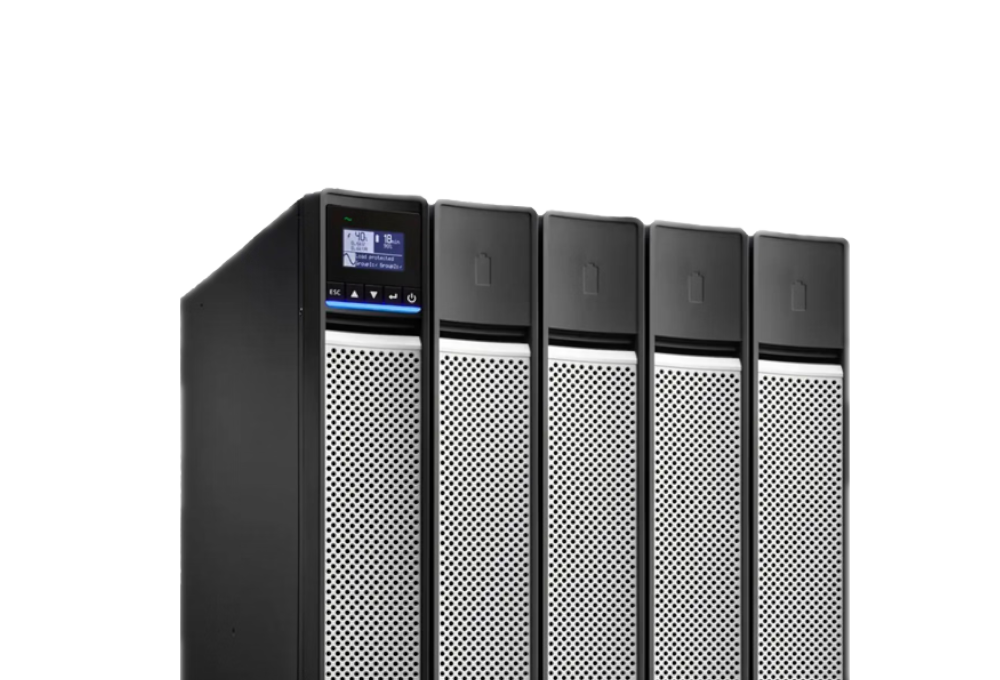
We specialize in sourcing UPS backup power systems precisely sized for the needs of your operation.
We'll help you choose the right UPS type and power rating based on your load profile, carry out the installation, and take care of regular maintenance including battery replacement.
IT infrastructure such as server rooms and data centers; healthcare facilities; laboratories and research centers; POS, camera, and security systems; production facilities using CNC machines or 3D printers.
Whether you need a design for your infrastructure or you're looking for service for your UPS, get in touch with us.
Contact Us About UPSUPS (Uninterruptible Power Supply) is a device designed to ensure steady, consistent power. Electrical infrastructure can be unreliable. Voltage fluctuations caused by the startup of power-hungry equipment on the grid can cause faults in equipment that's sensitive to stable power.
Equally critical is a total power outage, which can cause data loss, equipment damage, or a complete shutdown of operations. A UPS eliminates these risks – it bridges the outage, smooths out voltage fluctuations, and gives you time to safely shut down systems or start up a generator.
A UPS consists of a control unit that monitors the incoming grid power, and a set of batteries that serve as a power backup in case the grid weakens or fails. There are typically two popular ways of connecting a UPS to the grid, which is how UPS types are classified:
Both types regulate the incoming voltage to prevent fluctuations. A line-interactive UPS typically passes grid power straight through while regulating it slightly to make it more stable.
In the event of major fluctuations or a complete power failure, the UPS switches to backup mode, fully replacing the grid supply. For a line-interactive UPS, this switchover creates a 2–10 ms delay, which can be unacceptable for some more sensitive systems. For this reason, an online UPS is used in such cases – power is fully supplied by batteries that are continuously recharged from the grid, so no switchover delay occurs.
A third option is an offline UPS, which doesn't regulate the incoming power at all and only acts as a backup with a delay in the event of a grid outage. Its advantage is a lower price, but it's not suitable at all for areas with grid fluctuations or for sensitive infrastructure.
Every device has a different startup and operating load profile. The required UPS power output depends precisely on this load profile. Systems with demanding startup loads may need higher power so the UPS can handle their inrush current. During a grid outage, the batteries take over the power supply entirely. However, they're limited by backup time, which is directly affected by the number of batteries. A system should be sized so that the backup time provides enough time to start backup generators or to safely shut down the process.